The arrival of the Germanic-speaking peoples in Britain, known now as the Anglo-Saxons, and from which the modern-day English language descends in part, is a key moment in history of the English. Many historians give an account of it, known usually as the adventus Saxonum, or ‘the arrival of the Saxons.’
One of the principal Anglo-Saxon sources on this is the Anglo-Saxon historian Bede. His works are probably the most important written source for the study of early Anglo-Saxon history. His Ecclesiastical History of the English People tells the story of the island of Britain and its conversion to Christianity up until his death in 735.
Bede’s account of the adventus Saxonum, the coming of the Angles, Saxons and Jutes, is largely drawn from the work of the British monk, Gildas, who lived in the sixth century. His De Excidio et Conquestu Brittaniae offers a history of the island since the arrival of the Romans, and also rationalises the arrival and successful conquest of the Saxons, a pagan, Germanic tribe by blaming the sinfulness of the Christians in Britain.
Later historians continued to look back at his work, weaving in the traditions of other historical works as well. Two twelfth-century historians, Geoffrey of Monmouth and William of Malmesbury, use Bede in their account, but also the ninth-century Welsh work known as the Historia Brittonum. This tale draws attention to a snippet of history – or lore – that may be a hint as to the first ‘Anglo-Saxon’ queen.

The archetypal tale is that Vortigern, king of the Britons, unable to muster sufficient military forces from among the Britons, invites some Germanic armed men to come and fight their battles for them. After several negotiations, oath-takings and promises, the Saxons under the leaders known as Hengest and Horsa came to Britain and fought against the Picts. At a second round of negotiations, Hengest asked Vortigern to send back to Germany for more troops – something which Vortigern agreed to. However, Horsa had more than that in mind:
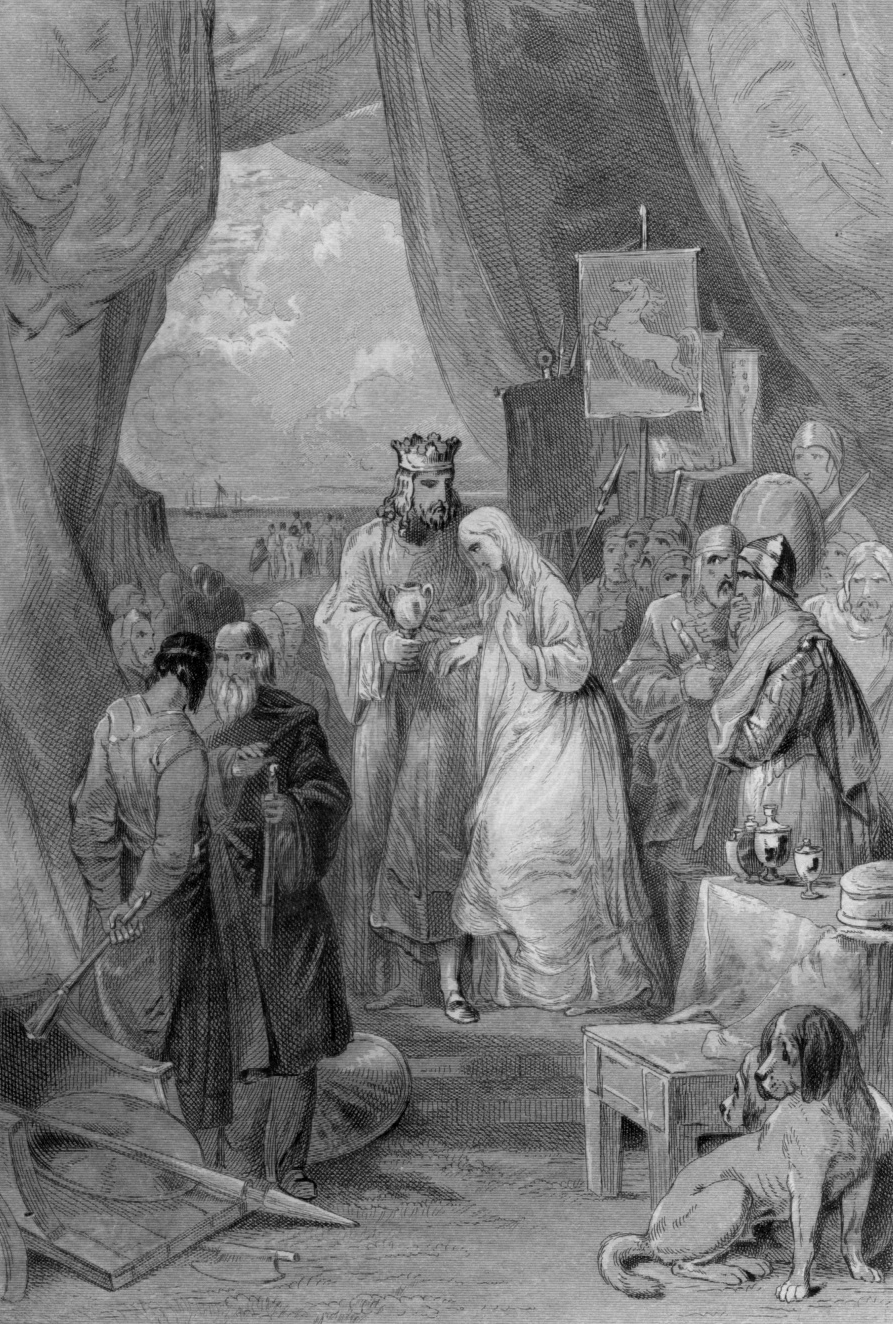
…[T]hey returned with sixteen vessels, bringing with them the beautiful daughter of Hengist. And now the Saxon chief prepared an entertainment, to which he invited the king, his officers, and Ceretic, his interpreter, having previously enjoined his daughter to serve them so profusely with wine and ale, that they might soon become intoxicated. This plan succeeded; and Vortigern, at the instigation of the devil, and enamoured with the beauty of the damsel, demanded her, through the medium of his interpreter, of the father, promising to give for her whatever he should ask. Then Hengist, who had already consulted with the elders who attended him of [their] race, demanded for his daguther the province, called in English, Centland, in British, Ceint (Kent)…
Historia Brittonum, trans. J.A. Giles, c. 37
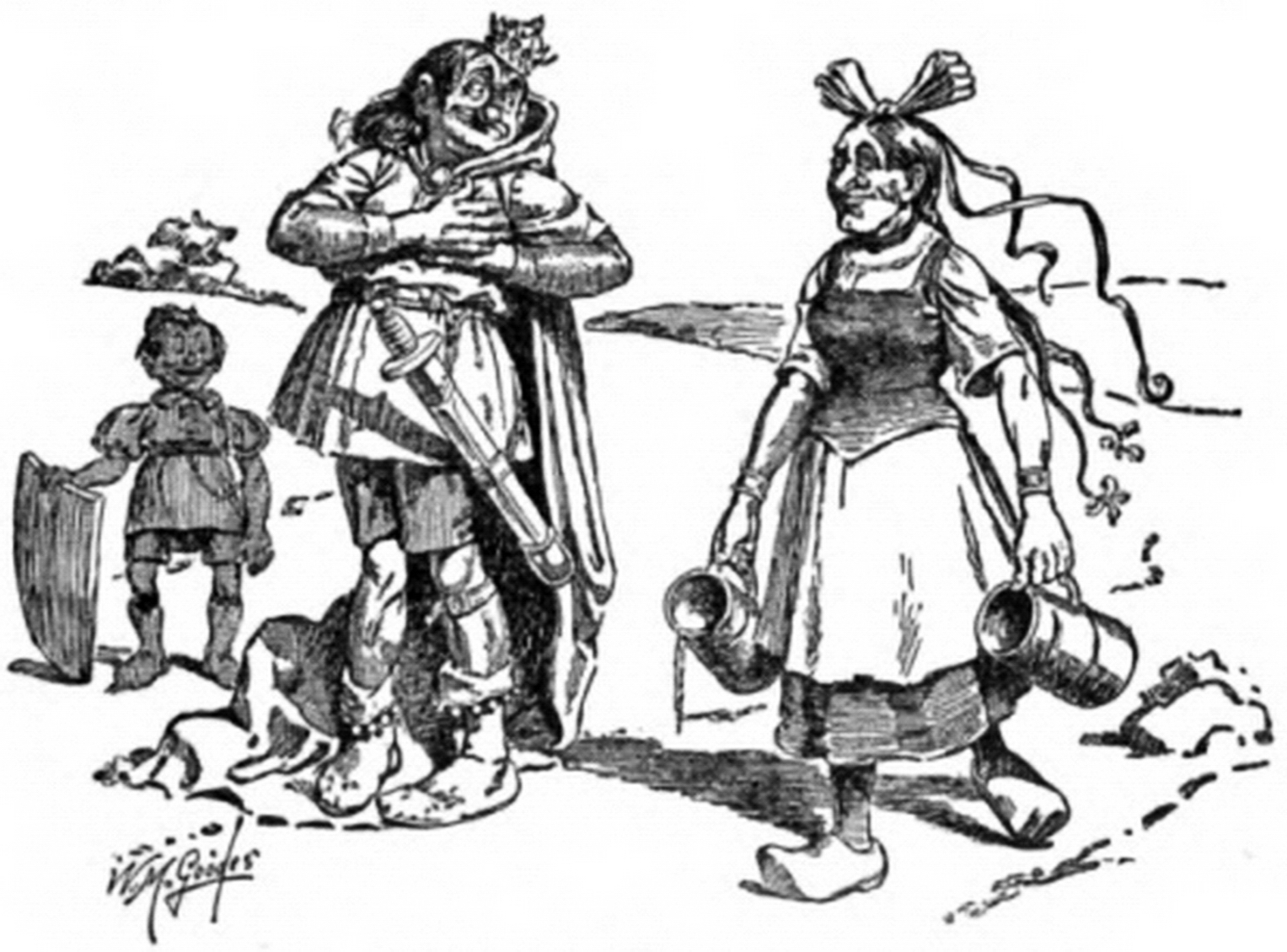
From there, though, the tales diverge. William of Malmesbury tells us no more of Hengist’s daughter after the agreement of her betrothal (c. 7), omitting her from a tale in which Hengist wickedly tricks and captures his own son-in-law (c.8). Nennius, however, gives an account of the tale, in which the Britons and Vortigern are invited to a feast, but spare Vortigern, as ‘on account of his marriage with my daughter, for it is better that he should be ransomed than killed.’ (c. 46). However, having escaped, Vortigern fled with his wives, one of which was his own daughter, and took refuge in a castle named Cair Guothergirn. St Germanus called down divine retribution for Vorgitern’s sins upon him, fire from heaven burned and consumed the castle, killing all within.
Geoffrey of Monmouth’s version is perhaps the most detailed and perhaps liberal. He names the daughter Renwein, and gives her a role in murdering Vortimer, Vortigern’s noble and upright son, by poison.
A certain evil spirit which had found its way into the heart of his step-mother Renwein immediately became envious of this virtuous behaviour of his and inspired her to plot Vortimer’s death. Renwein collected all the information she could about noxious poisons and then, by the hands of one of his serants whom she had first corrupted with innumerable bribes, she gave Vortimer a poison to drink.
Geoffrey of Monmouth, The History of the Kings of Britain, trans. L. Thorpe (VI.14)
He also makes her an active agent of her father in undermining Vortigern’s rule, sending messages between Vortigern and her father, and helping to conceal the duplicity of the greedy Saxons. This most detailed account is also the most damning: Renwein is a wicked, envious queen keen on destroying the good, noble Britons.
So, could Renwein, daughter of Hengist, be considered the first Anglo-Saxon queen? As a historical figure, it seems improbable. Bede has no version of this tale, though he includes somewhat similar material from the Life of Germanus (who, in Nennius’ account, caused the fire that killed Vortigern and his wicked wives).
There are elements to these tales that suggest some possible authenticity, but others which indicate that they may be detailed with tropes and reused material. As Barbara Yorke and Virginia Blanton have observed in their work on early Anglo-Saxon saints, later sources often tell us more about the times in which they were written than about their subjects. Blanton’s work has identified that specific details suggest an older source, perhaps a vernacular or oral tradition.
One trend observable in these tales that rings true attests to an anthropological trend noted by Gayle Rubin in ‘The Traffic in Women’; she notes that in many societies, women are exchanged almost as social capital, or in exchange for other goods. In this tale, Hengist dangles his daughter in front of Vortigern to be exchanged for land. Doing so also creates a social bond: in the Historia Brittonum, Hengest advises Vortigern
“I will be to you both a father and an adviser; despise not my counsels, and you shall have no reason to fear being conquered by any man or any nation…”
Historia Brittonum, trans. J. A. Giles, c. 38
Nennius on this occasion offers no criticism of Vortigern’s character, though later Hengist’s duplicitous nature is illustrated at the feast where Vortigern is taken prisoner. The marriage between Vortigern and Renwein has created a kinship between the two peoples, but as Rubin observes, ‘it is the men who give and take them who are linked, the women being a conduit of a relationship rather than a partner to it… if women are the gifts, then it is men who are the exchange partners…. Upon whom reciprocal exchange confers its quasi-mystical power of social linkage.’ However, this is arguably a failed link. The extent of Hengist’s regard for his connection with his son-in-law is to spare his life (in Nennius’ version; in Geoffrey of Monmoth’s, Vortigern is spared only for the value of his ransom). The story of the failed link with an unhappy bride at the centre is one all too common in Anglo-Saxon literature. Tales of Beaduhild on the Franks Casket, Freawaru and Hildeburh in Beowulf, The Wife’s Lament and others all suggest the frequent failure of marriage links, often called freoðuwebbe. In this instance, the failure of Renwein’s marriage to bring peace between the Saxons and Britons if anything recommends it as a plausible tale.
On the other hand, other elements are more suspect. Geoffrey of Monmouth’s account of Renwein’s poisoning of Vortimer contains stock elements seen in many tales in which queens become political scapegoats: Asser, a ninth-century historian records the story of a queen of Wessex, Eadburh, who regularly poisoned the king’s favourites, but then accidentally poisoned him. The tale is part of a myth used by the West Saxon court to explain why it did not anoint queens; later accounts of the murder of St Æthelberht of East Anglia blame the queen, Cynethryth, when earlier accounts in the Anglo-Saxon Chronicle laid the blame at the feet of her husband, King Offa.
The final factor in this assessment is her name. Nennius does not name Hengist’s daughter; Geoffrey of Monouth is the earliest to do so, and her name may be a corruption of Rhonwen, which could be connected to the Welsh word for “horsehair”. This wicked depiction of Renwein is associated with other wicked women in later Arthurian traditions, such as Morgan le Fay; even in Malory’s Le Morte D’Arthur, foreign queens continue to represent the instability and otherness which threatens the island and its governance.
It is possible, then, that the legendary heroes of the Adventus saxonum, Hengist and Horsa, brought a daughter with them, who was married off to a high-ranking British noble as part of a kinship-making exchange for social capital and to foster a closer relationship than that of a hired mercenary army. Whether she had any role in the breakdown of the relationship that, as most historians argue, was the fault of the untrustworthy, pagan Saxons, is impossible to say. Even her name may be derivative from those of her father and uncle, whose names translate roughly as ‘stallion’ and ‘horse’. Renwein could be regarded as the first potential Anglo-Saxon queen – a Saxon woman taken as another wife by a British queen – but, rather like her father, uncle, and husband, she is best considered as legend.
 Anglo-Saxon Queens